Showing posts with label functions. Show all posts

Monday, September 21, 2015

PreCalc Function Characteristics part 2

So we continue examining various characteristics of functions. Part 2 is looking at piecewise functions (and specifically how to do them on our graphing calculator) and then continuity in functions. The later is really just visual at this point - it's something they'll explore more in calculus.

Piecewise functions

Students have already explored these in Algebra 1 & 2. They should remember what they are, how to graph them and how to evaluate values in a piecewise function. I know in my Algebra 1 class we do some real life examples too so students see where piecewise might make sense. 

Here we do a tiny little review but then really look at piecewise in the context of continuity (and determining the domain & range).

We do a notes page in our interactive student notebooks (ISNs). Then students try to create a piecewise picture on their graphing calculator given instructions. 
After that we create an ISN page showing our results. 
Students were pretty excited about this.


And I use this opportunity to plug my "graphing calculator project" that they get in December. In this project they draw a picture on their calculator with pieces of functions. At least 30 pieces, usually more like 50 or so. It's a great project. Will blog about it later. Students love it. And it's really time consuming. But great. 

Okay, now we've reviewed piecewise functions and have covered rational functions. We can now ease into what "continuity" means. We really do this more visually than anything else. But we do categorize the types of discontinuity.

We start with a foldable of course, in our ISN.
We fill the inside in. I use my document camera to project and fill things in with the students.

Behind the left two doors:
and the right two doors:

And then on their "right side reflect" page opposite this foldable students work through 4 examples. Here is the work for those examples:


From here they have some homework and two classes from now I'll be giving an assessment to see how they are at analyzing functions with the tools we have so far (domain, range, boundedness, asymptotes, continuity).

And part 3 will be looking at the basics of limits & describing end behavior with limit notation. After that part 4 is symmetry in functions (even vs odd).

Foldable documents can be found here. 


Thursday, September 3, 2015

PreCalculus Parent Functions


Our first unit in PreCalculus is essentially function analysis. Students learned about a few parent functions in algebra 2 last year and did some analysis. We are going to round things out and look at all the parent functions and sort of formalize our analysis with more complicated examples.

So we start off by exploring the parent functions. I've organized this in different ways over the years. And I'm pretty happy with my categories now. We do a big project later this semester where students create a picture on their graphing calculators using piecewise bits of as many parent functions as they can. The more variety of function types, the more points they can earn. So I wanted nice clear categories for my parent functions.

This is what I have:


1)  The Identity (or Linear) Function f(x) = x    

2)  Quadratic Function (even power polynomial parent)  f(x) = x2                                             

3)  Cubic Function  f(x) = x3  (odd power polynomial parent) use window  [-6, 6] [-4, 4]   

4)  Absolute Value Function  f(x) = |x|     also can be seen as the original piecewise function 

5)  Rational or Reciprocal Function (negative exponent power function)  f(x) = 1/x

6)  Square Root function  f(x) =  sq rt x (fractional exponent power function)                            
7)  The Greatest Integer Function  f(x) = int(x) also written as f(x) = [x].  also called a step function. 

8)  Exponential FUNCTION   f(x) = a(b)x     we break this down by looking at two graphs for this function; GROWTH when b > 1 (do f(x) = 2x and DECAY when 0 < b < 1 (do f(x) = (1/2)x). 

9)  Logistic Function   

10)  Logarithmic Function  f(x) = ln x   

11)  Sinusoidal Function – examining graphs for both Sine Function  f(x) = sin (x)      and   Cosine Function  f(x) = cos (x) 

12)  Tangent Function  f(x) = Tan(x) 

Students start summarizing these by doing a little exploration on their graphing calculator. In their ISN they will draw the graph for each function and identify the domain & range. They use this worksheet to guide their work.

Here is what my pages look like so far in the ISN. (I messed up and cubic function is in the wrong order, sigh, but they are all there). And later we will fill in some other interesting characteristics of those functions.


Monday, July 13, 2015

What is a function?

What's the best way to teach functions?

This can be a pretty obscure and abstract concept. I've tried many different things over the years to develop some understanding for students while also establishing some relevance. I'm still looking for something perfect to introduce this concept.

I like Dan Meyer's look at functions. He commented ....
Next Week’s Skill
Determining if a relationship is a function or not.
This is another skill that can become quickly instrumental (run a vertical line over the graph, etc.) and obscure why it is aspirin for a particular kind of headache.
Let us know your ideas for motivating the definition of a function in the comments.

He gathered up feedback from others and put together a nice blog post on this "headache". Check it out at

If Functions Are Aspirin, Then How Do You Create The Headache?

I like his approach to considering that functions provide you with certainty. I think I will try a variation of his "game" to introduce that idea to students.

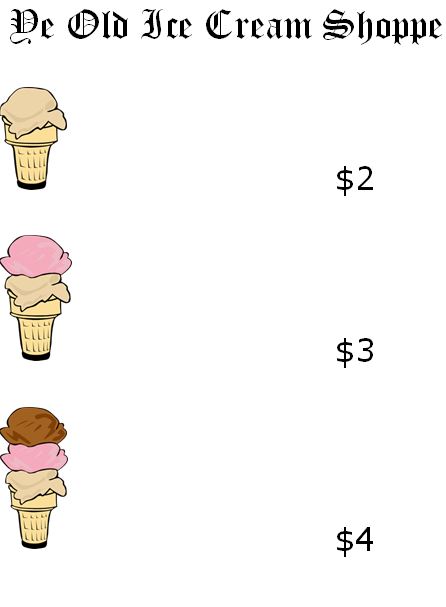
Then I'll do an more abstract peak at what that means (remember we established what a relation is. Saying something like "what does this mean algebraically?". Perhaps I will use something like you see in this Khan Academy video "What is a  Function".  But then I always like to acknowledge how tricky it is to understand what is meant by "every input has exactly one output" - what does that feel like? How would it not make sense to have one input have multiple outputs? So I like to explore this a bit more concretely with students to create some relevance with the idea of certainty. I like doing the "Ice Cream Shoppe" example (I may use this as a foldable....).It's just a clever little situation that applies the idea of functions to a real life situation.

Ye Old Ice Cream Shoppe

A new ice cream shoppe opens in town and you get a part time job there. I have a visual with one scoop, two scoops & three scoops to go with this. We look at three scenarios.

scenario #1 the regular prices for the ice cream cones are $2 for one scoop, $3 for two scoop and $4 for three scoop. We map this on our diagram. Every input (cone size) has exactly one output (price). So this is a function and in fact it is a one-to-one function. This is clearly well defined, predictable, and "makes sense".


scenario #2 it is the grand opening of the shoppe and for the day all sizes of ice cream cones are $2!  Yay! so we map this on the diagram. Every input (cone size) has exactly one output (price). Yes, they all have the same price, but that's okay. It's still a function. This is also well defined, predictable, and makes sense. It is a function. 

scenario #3  your boss is out of the shoppe for the day. Your best friend comes in and he orders a 3 scoop and you charge him $2 (!) Then your least favorite person comes in and orders a 3-scoop and you charge him $5! Whoa!  Wait a minute, the input of a 3-scoop has two different outputs in this scenario ($2 and $5). Even though this might make sense to you it's really not a good thing to be doing. It is not well defined or predictable (who knows what you will charge the next person who orders a 3-scoop).
the visuals above haven't been "worked through" with the mapping arrows and labeling input/output (domain/range) and commenting on whether they are functions and why or why not. This is all something students would do. 

Interactive Student Notebook Pages for Functions

I do a couple of pages. First there is a frayer diagram on the left and sorted function cards opposite that on the right hand side.


Then we do two pages for domain & range. The left hand side compares continuous vs discrete with information about domain & range.  Here are examples for students to work out on the right side reflect under the DIXROY.  We already learned how to write interval notation, so I have them do that with domain & range.


Then I do a two page spread of "Function Machines & Function Notation" with examples on the right hand side. The "under examples" we just filled in with no foldable.


Links for each of those are contained via the descriptions above. 

Sarah Hagan has a lot of other good ideas on her blog math=love. You'll see I got a lot of my ideas from her!  Thank you again Sarah!

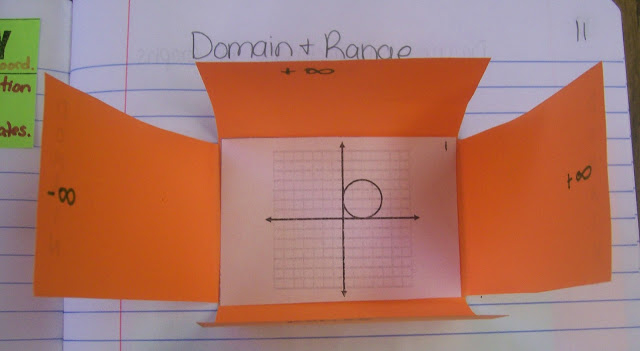
Addendum on domain & range. I found students had trouble with identifying domain and range in graphs especially when it got tricky. So my plan is to add one more foldable to this series here borrowing once again from math=love (this time her algebra 2 page on functions). She's got a great set of foldables and explore cards to visually understand domain and range. Read the whole entry on her blog if interested, but here are some images to give an idea of what she did.


But remembering how long cutting can take with my students and Sarah's comments about that, I will use my trusty cutting board to get those cards cut up ahead of time (or have them cut them at home the night before....)


Friday, July 10, 2015

Starting Functions - Independent & Dependent Variables

The next unit in our Algebra One course is "Functions". This can be a pretty abstract concept. I struggle with finding ways to make the concepts accessible to students.

(here comes why/how learn mathematics ramble.....)

 I HATE having students just memorize. I want there to be some context that I can couch concepts in; having them relate it to real life or see how it connects to mathematics they already know. It's great to be able to justify everything students learn with a "when will I ever use this" example. But also teachers shouldn't get too wedded to doing that. Sometimes I teach a mathematical concept with a lot of enthusiasm because I love the beauty of it (I say things such as "now this is really cool") or because it provides some essential structure to a larger overall concept the students are already familiar with. I'm always reminding them that mathematics is a very large system/language that us humans are always in the process of discovering and defining. We are not "making it up" - it's out there, it defines the structure of the universe, it's the language of science, etc.... I try not to go off too much on this marveling ramble but I want students to see how immense and powerful mathematics is.So when they might think something they learn is silly and meaningless I want them to remember it is an important cog in something larger than they can imagine. (talk about abstract!). I know my enthusiasm about this goes over the heads of many students but you can see some grab onto it and a little twinkle come into their eyes. And these are usually kids who are quite smart but never saw the use of mathematics. It's really cool when I see that.

Okay back to functions... 

we start with something a bit abstract that can be related to real life ...Independent and Dependent Variables!

I actually start this concept right after their test in the previous unit. I'm a big fan of giving students some pre-assessment type thing after a summative assessment. One to keep them busy if they finish early and two to get them thinking about the new material (and dusting off what they already know). Our students learn all about independent and dependent variables in science class, so they are familiar with them. Now we just want them to transfer this knowledge into an algebra setting where we eventually connect it to domain & range. So they get this preassessment after their last test. 

We start the next class by discussing what they came up with. Students come up with some neat independent variable ideas for the dependent variable "your level of happiness". 

Then we summarize what we know in general about independent and dependent variables (seen on top  half of this ISN page - which I might try to flesh out and do as a full page, saving the "right side reflection" page for their homework that night (see mini poster idea at end of this blog). Link for top half defining foldable.   Thought for fleshing out...here is the document..... Relating this to algebra, sneak in a first mention of function notation....

Then students do and independent/dependent variable card sort in their ISN. (next year will do as a two page spread). See the first bit of it above and it continues on a second page:

Students could write function sentences for each IV-DV pair. For example "The number of people you will be able to serve is a function of the number of meals you prepare".

Here are some documents you might find useful..


But something I'm looking at for next year...

And this looks pretty cool to me, might want to try it for the first HW. Blogger Tom DeRosa calls it a project, but these little mini-posters are cool for a homework assignment.

Full details can be found at his blog post "I want to teach forever".