Showing posts with label inverse functions. Show all posts

Wednesday, February 17, 2016

Inverse Trig ISN and Evaluate

We set the stage with our "exploring inverse trig functions" and now we move into how we use them in this course. We take a few minutes at the start of class to summarize what we learned with the explore by filling in a little ISN booklet of three pages (one each for sine, cosine & tangent):


Recall that you can "undo" any trig operation with its inverse to find the angle (such as in solving right triangles or other triangle application problems). What I am asking students to do now is to find the range value for a given domain value of a trig inverse function. 

Very subtle concept here. Students have to be very solid with their trig ratios to be successful here. Basically what we are doing is finding the angle when we are given the ratio. This can be very difficult for some students.

What I do is go over a few problems with them such as


and refer to the unit circle visuals for the inverse trig function


I remind them that the domain of the inverse (for sine & cosine) is very limited. We can only evaluate values between [-1, 1]. When the ratio is negative I ask them questions to help them remember that the original sine ratio is the y-coordinate in the function and where is the y-coordinate negative in the restricted unit circle visual?

Basically students came up with these "thinking steps" for evaluating:
1) look at the ratio - what special or quadrantal angle results in this ratio?
2) now be careful - what is the sign of the ratio? If it's negative think about which inverse trig ratio we are using and where the negative ratios reside in the "unit circle connection" we drew above. Use that to determine the angle.

I also ask,
 "which inverse trig ratios can have negative angles in their domain? which can only have positive angles in their domain?"

I like to keep them thinking with this one

(I ask them "what is the domain of arcsine?".....and what is the numerical value for pi?)

After a few examples students practice "how to evaluate" inverse trig ratios with this foldable:


And then I work through a few "double evaluations" such as:
        

You've got to be careful with the second one as the inverse doesn't always just undo the operation with the result being the given angle. 

And then to keep them on their toes I give them one of these. All kinds of confusion zings around the room as students try to remember what special angle has that trig ratio. When I confirm that there isn't one, I tell them that we really don't need to know the angle. We are ultimately just finding the trig ratio for cosine of some mystery angle. 

with some prompting the hope is that someone will remember that the tangent ratio is y/x and the cosine ratio is x/r so all they need to do is figure out r with the Pythagorean relationship for x, y & r.

Finally students use this foldable on the page opposite to practice these evaluations.

this double evaluation goes on top of the evaluation page - I glue the evaluation page onto the notebook page and this page gets taped across the top creating a little flap over the evaluation page. 

I also have a worksheet of practice for students. Preview of first few problems:


All my files on Inverse Trig Functions can be found HERE (and this is everything - introduction sheets, evaluate sheets, ISN materials, answer keys)

Thursday, February 11, 2016

Introducing Inverse Trig Functions


So I've been reading a bit about inverse trig functions on line and how people approach teaching them. It got me thinking about what my focus is with inverse trig functions and inverse functions in general in PreCalculus. My thinking is that students in Algebra 2 learn about inverse functions and the mechanics of inverse functions (how to create graphs, how to create inverse function equations, what they mean in terms of real life situations). PreCalculus is a time to dissect the idea of inverse functions more deeply in a bit of a more theoretical way. Are there limitations to the inverses of functions? Is every inverse of a function a function itself? We explored these questions back in the fall and it was hard for students. I have a good set of classes, honors level but they have been used to learning processes and procedures and not really developing a deeper understanding.

I like to start out these lessons on inverse trig functions by having a discussion about the difference between inverse operations and inverse functions.  This sort of maps out our discussion (I lead the discussion with questions - what is an operation? what is the inverse of that operation? Let's consider an operation we all know pretty well - "squaring" - what does that look like as an operation? as a function? as an inverse operation? as an inverse operation?).

Then I steer the discussion to trig ratios as operations, as functions, etc. I try to do this by asking as many questions as possible.

Then after the discussion I distribute an "explore" packet to students. We do the first page together (it's just a review of inverses with quadratics and the domain & range restrictions). Then students work together in their small groups and using their graphing calculators work on visually representing  and defining domains and ranges of inverse trig functions.  I put a big focus on the visual (it's how I learn best and I find students often learn better that way too),

I thought I'd visually go through what we do & students do with the explore packet. You can open a blank electronic version of this worksheet at the end of the post.

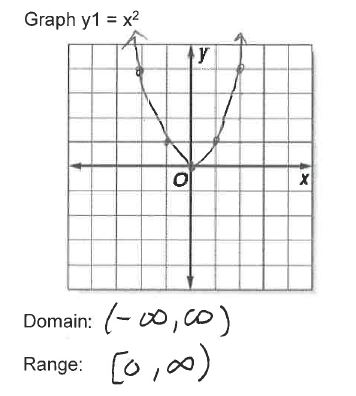
We use TI-84 or TI-83 graphing calculators. We graph a basic quadratic and state the domain & range:


Then using the DRAW menu we can actually see the true inverse without restrictions of this function. We do that and draw it. Discussion ensues with "what's wrong with this picture?"

From there we remember that the inverse of the quadratic is the square root function. We draw that. We carefully examine the graph and the function equation to be clear about the domain and range. 

A little "mantra' we chant is the the domain of the inverse comes from the range of the original. This is verified and we see how it restricts the range. All this is review of something we did back in the fall.

Now students get to work on their own doing a similar process to sine, cosine and tangent. These bits below show ideally what they should be coming up with. If there is time I have three small groups present what they come up with for each and explain. Then I lead the discussion into how these relate to the unit circle. That will continue in my next post (we pull it all together in some ISN inserts).

SINE:


COSINE:


TANGENT:


Is this good math teaching? I hope so. I just remember when I first started teaching PreCalculus 10+ years ago. I was equipped with my previous learning as a precalculus student many many years previous and a bunch of textbooks. No real curriculum. When I got to inverse trig functions I had to ask myself - what are these really? What do I want to know about them? How can I make sense of them in relationship to everything else I know about mathematics? I have a hard time using problem sets in textbooks to drive my teaching. I like having a deeper understanding of how things work rather than just know how to solve given problems.

We do then go onto apply these ideas to problems. But I'd like to think of another way to assess understanding than just evaluate inverse trig functions. Maybe some writing prompt for the students to respond to.

All my files on Inverse Trig Functions can be found HERE (and this is everything - introduction sheets, evaluate sheets, ISN materials)