Showing posts with label exponents. Show all posts

Monday, July 27, 2015

Algebra One Unit 7 Properties of Exponents

After our introduction day of laying the groundwork we get into all the properties. Since my students have seen this material before we can take one of two approaches. I have to gauge how strong a group I have each year. I think they will continually get stronger and I will eventually be able to do option two for everyone. Remember I have an advanced class so this will be easier to do.

Option One - work through each property

Develop each property with students. I like doing discovery work on this. But I also find that students "remember" the rules but can't justify why they work. So I may "tweak" my discovery sheet to be clearer about justifying results. After going through each property then proceed into option two.

Option Two - Students do around the room activity to gather examples for properties.

So they know the properties and now can they identify examples that illustrate each? They are given a summary of properties worksheet to find examples for and fill them in. Examples are taped around the room. They can work together. Teacher is walking around with a master key to assist students only if absolutely necessary (and be stingy with the help - ask questions of them back or say hmmm... that doesn't look like that should go there). I tell students how many examples they are finding for each. See the master key for the examples. I write them on half page sheets of paper and tape them around the room. Students have to simplify each as well.

Other useful practice for students:
A Puzzle Partners worksheet
An All Properties worksheet with lots of examples and the answer key.

And there is an ISN insert too that students put into their notebooks. my student teacher did these inserts, she did a great job, but I'll probably do some tweaking so will post my new items in 2016 as I do them.


*did I tell you what cool handwriting my student teacher has?

Powers and Negatives can be a tricky combination, so we made an ISN summary sheet for that (found it on pinterest and the blog domain page has expired but it was called somebecomepearls.com).
and it appears that I forgot to take a picture of the inside three doors - so this is from pinterst:


Other useful practice for students:
A Puzzle Partners worksheet
An All Properties worksheet with lots of examples and the answer key.

Of course after this I do give my students a summative assessment (quiz).  After the quiz they take this little handout and then we talk about radicals - squares and square roots once everyone is finished with the quiz.

We go through the first 15 perfect squares and their square roots. We also talk about other roots too and list the first 5 perfect cubes and their cube roots. All students should memorize those perfect squares and cubes - they are all good number facts to have easy mental access to. I usually do a quick memorization quiz early on for this. (yes there are some things that just need to be memorized).

To support this radical work, I want an ISN insert on radicals.  this is not in my notebook but I want to use it in the 2015-2016 school year. Thank you again Sarah Hagan from math=love  (I think I'll make the first page a "booklet" so inside students can write the perfect squares and cubes they have to memorize.)


Then we get into rational exponents - this can get kind of tricky to develop and not just "tell".  Here are some rough notes of what I do in general after the quiz on regular exponent properties and leading into rational exponents.

Then there is an ISN insert

We had students convert back and forth between radical and exponential notation.

Then we had students apply the properties of exponents to rational exponents. Here are some worksheets that I used. 

Here are my ISN masters.  I can't find the master for squaring a negative, so I will double check with my student teacher and post it once I find it OR make another one.


Sunday, July 26, 2015

Unit 7 Laying the ground work for Properties of Exponents

When we were first starting our curriculum writing for unit 7 we were once again horrified to see that students start with properties of rational exponents. This is in Algebra One. I've always taught the initial properties of exponents with integer exponents. I guess students will now learn this in sixth grade so that by ninth grade they are all set and we can go write into fractional exponents. But my students are very far from that reality (especially since our first common core year in Algebra One was also the first year they did common core in 6th grade in our school system). Yes, students see the properties in Pre-Algebra (8th grade) but have no understanding of where they come from, they just remember there were some rules they memorized.

So back to square one.

I'm a big fan of develop the knowledge, don't memorize rules. That way you can recreate something you may have forgotten the details for as long as you can remember the basics and develop knowledge. My high school years (in the 70s) were spent memorizing formulas and being discouraged from asking why. Very frustrating! So as a high school mathematics teacher I feel it's important to develop those whys.

This blog post is on a discussion day that I have with students in reviewing some properties of mathematics and reminding students of the awesome power of ONE!  (who would think ONE would be such a powerful number!).

After the unit test from the previous unit - I jumpstart thinking with this exponents vocabulary puzzle sheet. They complete that for homework.

Then I have students do this worksheet as a warm up - all problems they should be able to do from their previous experience with exponents.

So now we are ready for our discussion class. After going over the warm up I refer to the following (written on the board):
·          1)  Definition of Exponentiation
·           2)  Commutative Property
·         3) Associative Property
·         4) Identity Property of Multiplication
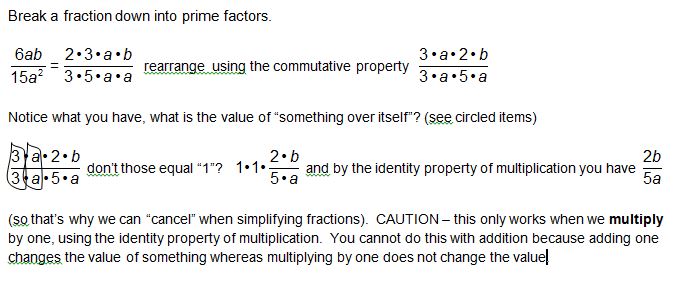
·          5) What's behind the process of simplifying fractions (or why "cancel" is a dirty word)

    We talk about what each of these mean. Here's a basic "script" of how our discussions go (I typed it all up one year to have a hard copy). I don't just talk through all these things, I ask lots of leading questions and ask students to give me examples. They should know all this material, they just need a kick start to remember.

  1) Definition of Exponentiation

The exponent of a number says how many times to use the number in a multiplication.
In 82 the "2" says to use 8 twice in a multiplication,
so 82 = 8 × 8 = 64
Some more examples:
Example: 53 = 5 × 5 × 5 = 125
  • In words: 53 could be called "5 to the third power", "5 to the power 3" or simply "5 cubed"
Example: x4 = x · x · x · x
  • In words: 24 could be called "2 to the fourth power" or "2 to the power 4" or simply "2 to the 4th"
So, in general:
an tells you to multiply a by itself,

so there are n of those a's:


  2) Commutative Property
The word "commutative" comes from "commute" or "move around", so the Commutative Property is the one that refers to moving stuff around. For addition, the rule is "a + b = b + a"; in numbers, this means 2 + 3 = 3 + 2. For multiplication, the rule is "ab = ba"; in numbers, this means 2×3 = 3×2.  

3) Associative Property
The word "associative" comes from "associate" or "group";the Associative Property is the rule that refers to grouping. For addition, the rule is "a + (b + c) = (a + b) + c"; in numbers, this means 2 + (3 + 4) = (2 + 3) + 4. For multiplication, the rule is "a(bc) = (ab)c"; in numbers, this means 2(3×4) = (2×3)4.     

                      4) Identity Property of Multiplication
The identity property of multiplication, also called the multiplication property of one says that the value of a number does not change when that number is multiplied by 1.

Copyright
5) What’s behind the process of simplifying fractions…(and why you can’t “cancel” when it’s addition)

What allows you to simplify fractions?

A somewhat extreme meme to emphasize the horror of this type of mistake.....

http://mathcurmudgeon.blogspot.com/2014/01/do-this-and-bunny-dies.html 

And I wrap things up by having students do this worksheet for homework.