Showing posts with label geometric sequence. Show all posts

Monday, June 12, 2017

PreCalculus Sequences 2017


https://risesa.wordpress.com/tag/foxtrot/

We end the year in PreCalculus with two mini-units. This is the first lesson in the first mini-unit "Sequences & Series". is on sequences. Students learned about sequences in Algebra One (many courses ago) and learned the general formulas. We apply those formulas a bit more and then progress to series. When we have time we do a full unit on "Discrete Mathematics" which includes combinatorics (permutations & combinations), binomial theorem and probability. But this year we were running short of time. The Calculus teachers wanted us to be sure to get to series and summation notation - thus the inclusion of this mini unit!

Back to sequences.


I start the lesson at the end of the last unit test. As they finish the test, students take a sequences review sheet that reminds them of the preconcepts they had learned in Algebra One.

We start the actual lesson with a frayer diagram on sequences.

Then we defined each of the types of sequences with this foldable. Inside the foldable you will find the details.


I did include a "neither" category because Fibonacci sequences are very cool and the sequence of perfect squares is pretty common yet is neither arithmetic or geometric.

Next we reviewed the arithmetic and geometric sequence formulas. I do like to spend a little time showing how each formula relates to example. I like them to see how the arithmetic involves the repeated addition of the common difference (thus appears as multiplication in the formula) and the geometric involves repeated multiplication of the common ratio (thus appears as a power in the formula). I use this foldable to summarize  the formulas.


Inside there are examples.


I like my precalculus students to apply these formulas in constructing sequences also. These problems involve creating a system of equations using the general formulas. The geometric one is interesting because you solve that system using division, not a typical operation used in solving systems of equations.

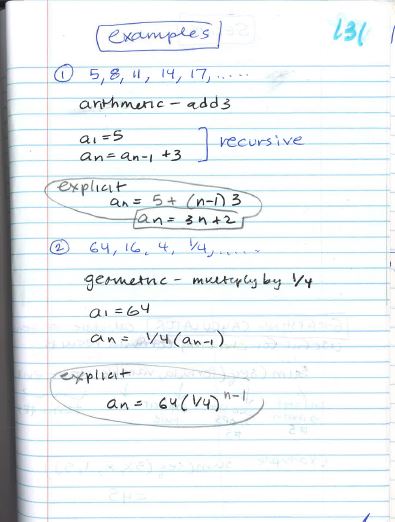
Finally if I have time (we do have an 82 minute block) I like to do a quick comparison of explicit versus recursive rules. The focus in this course is the explicit rules but recursive rules are useful, especially in computer programming. These pages show my overview.

I like to use our TI 84 graphing calculators to experience the recursive rules too. We go through an arithmetic sequence - first we type in the first term (let's use 8) and press enter. This will give you the first term and establishes the first term in your calculator. Then we type the rule (let's say d = 5, so they would type +5). That establishes the rule in your calculator.  And it will give us the second term. With those two steps the recursive formula has been programmed into your calculator. Now you can use this recursive program to generate additional terms. Each time you press enter you will get successive terms starting with the third term.

For homework, I give my students examples in our textbook to complete.

Here is the folder on box.com that contains the ISN masters for both sequences & series.

Sunday, September 6, 2015

Algebra One More on Geometric Sequences


I posted earlier this year with my ISN materials on geometric sequences in Algebra One. This post is to flesh things out a little bit. This all takes place over three blocks.

We finished up arithmetic sequences and I introduced geometric sequences by posting two sequences on the board (one with r = 2 and the other with r = 1/2) and asked how these were different from the arithmetic ones we just did. Discussion ensued with question about what the graphs might look like? So we graphed them and noticed they didn't look "linear". (are these supposed to be straight?). Why aren't they "straight"? - because of how quickly they grow. Anyone know a word that describes growth that might start slow but then speeds up very quickly? (exponential). We explored a few different sequences and looked at some "application type" problems (bubbles, bouncing ball).

It was easy enough to create recursive rules for these. It was the explicit rule that was a little harder. So we broke down what actually is happening term to term. Here's what that looks like:


How does the number of factors relate to the term number? (one less, thus (n-1)). So from there we developed the explicit formula.

Then we had a summary with our ISN foldable.


There was some confusion - some scenarios described "starting" with something and then data for after the first, second, third (etc) minute (or some other unit). So the start is really the "0 term" when creating formulas. We explored how the explicit formula with the zero term means the same thing as the formula with the first term. This takes a few examples to recognize. Have students explore this and see how they are the same.


This distinction between the two is pretty important and helps to later relate these easily to exponential functions. 

Now we go into class block #2 on this topic. I started with the "birthday problem" as a warm up (see documents below). They compare two scenarios to decide which is better. Discussion takes place when they recognize they are examples of arithmetic and geometric sequences and that geometric is a far better option. 

Next we looked at scenarios that involved percentages. Here are two examples we discussed:
o   Ex 1 – special hair potion, hair will grow 5% a week. Start with 8 inches.
o   Ex 2 – your jeans will shrink 5% in length very time they go through the dryer. Starting length = 32 inches.

They had to learn how to translate percent growth & decay into sequences, finding an "r" value. So this took a little time and exploration. They can do percentage change but do it as a two-step process. The trick was to get them to recognize that "growth" results in something greater than 100% thus in example 1 r = 1.05 (105%) while decay results in something less than 100% thus example 2 r = 0.95 (95%). I don't like to just tell them how this work, I like them to play around with the numbers to try to figure it out first and discuss amongst themselves. I usually end up doing a little of both because of time constraints.

Then students had a bunch of practice problems to do. A good idea here is to have students make up a growth and a decay scenario and create a sequence to go with it. Students get super creative with this.

Then we went into class block #3 on this. Warm up was some practice problems to go in the ISN opposite the foldable pages.


Finally we examined geometric sequences in the context of fractals. Most of my students never heard of a fractal. So we first did a little intro worksheet together of drawing a simple fractal design. From there we went to Sierpinski's triangle. There is always some moaning & groaning here, do we have to draw stage 4? I leave that up to them, if they just want to recognize the pattern and state how many USRs there are, that's fine. (but there are always a good handful who do want to draw it!).


 And we finish up class by watching a few youtube videos. Students explore Koch's snowflake for homework.

fun with fractals:

fractals in nature


Koch's snowflake zoom:


All the documents can be accessed HERE

Sunday, June 28, 2015

Sequences Algebra One


I am used to teaching sequences and series in Algebra 2 & Pre-Calculus. But four years ago when we were given the task of aligning our Algebra 1 curriculum with the Common Core - lo & behold the first unit was "Patterns" which really was all about sequences - arithmetic, geometric and other sequences (Fibonacci, etc). And they wanted us to use function notation rather than sequence notation and students were supposed to naturally discover the formulas for a term in an arithmetic sequence and geometric sequence, ha! We gave it our best shot. After teaching this unit for three years I see now that the Common Core no longer has this as their first unit and that sequences are blended into other units. We have fine-tuned it over the last 3 years and aren't going to toss it just yet. Connecticut is making their own "Algebra for All Common Core" curriculum, so we'll just wait and see what they want us to do (it will include an end of year exam for all students in the state taking Algebra 1).

It's actually kind of fun to start with patterns, it gets students thinking mathematically. I have students do some exploring with patterns in worksheet they get for homework on the first day of school. You can find that here.

Then we develop the concepts & vocabulary. And "come up with" the arithmetic formula using what they already know about the slope intercept form of linear equations (y = mx + b) from there they see they have to find the "0 term" for the equation/formula. Geometric is harder to develop, so we kind of just give it to them. We revisit both sequences when we do linear and exponential functions. Overall it's a short unit with a cool little performance task at the end.

Foldables for Sequences

I use three sets of foldables for my ISN. Remember my page numbers are all wrong, I'm going to be better about the left side even & right side odd this coming school year. Also these are my first attempts at foldables and I'm not crazy about how everything lined up. I got better at that as the year progressed. The heading for each is a link to access that foldable via box.com.

INTRODUCTION TO SEQUENCES


ARITHMETIC SEQUENCES


GEOMETRIC SEQUENCES


Those are all Left Side Learning Pages (3 in all for this unit). The Right Side Reflect pages for opposite arithmetic & geometric are:


I don't have the actual examples - just notes to myself as to what to have students do.

And we do some cool stuff with the recursive rule and our calculators (TI-83 or TI-84). You can set them to generate a sequence recursively just by kind of following the rule. Type in the first term, [enter] then type in [+] "the common difference" [enter], You will see the first & second terms on the calculator screen. Then just keep typing in [enter] to generate more terms (the 3rd, 4th, etc). Not especially efficient if you want the 50th term but it's cool to do. And we talk about this is how computers generate terms. But they can do it super fast.

And if you are interested in my performance task, it's kind of cool. I made a honeycomb model out of cardboard for students to see what the core of the table looks like. Of course that is at school so I can't post a picture yet! Honeycomb Performance Task with the exploratory task we do the day before the PT and honeycomb graph paper.