Showing posts with label range. Show all posts

Monday, November 9, 2015

Domain & Range Tool

I blogged about this domain & range tool a bit in a post this summer  but today I used it in the classroom and it was really great and I wanted to share this again with updated pictures to show how it worked out.

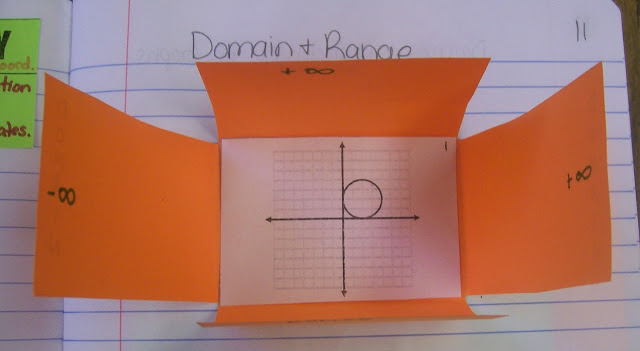
Domain and range from a graph can be quite tricky. I do this with my advanced algebra one group. This domain & range finder tool is a great way to visualize the domain & range.

They did have some homework last night that involved identifying which graphs are functions and trying to determine the domain & range of each (we had already defined domain & range and even filled in the DIX ROY bit the last class). Most kids came in to class today saying they didn't understand the homework. After going over homework we created our domain & range finder tool.

This tool can be a little "fussy" and I warned the students that today is a bit "artsy-craftsy". I really avoid doing anything too complicated with my foldables - there is the danger of it becoming a folding-cutting class rather than an algebra class. So I prepare quite a bit ahead of time. And I time the cutting and folding tasks to be done while I check homework and help students out in their small groups so it doesn't take away as much instruction time.

I also prepped by photocopying and doing some preliminary cutting with my paper cutter - so worth the time investment.

First everyone gets a pre-cut domain & range finder tool (we only have to fold it):


And an envelope foldable (partially pre-cut) and two strips of domain & range cards (8 cards all together).


We folded the tool and the envelope and glued everything in our notebooks before proceeding.


I walked through three cards with them, showing how to use the tool and how it helps us find the domain & range. So cool. So visual.


They had to finish the other five cards.

Then do the purple graphs on their notebook pages.

Then go back and do the back of the homework (some really challenging ones on that!).

As students worked I displayed answers via my document camera. More practice on a HW worksheet. Quiz next class!

All my documents can be found HERE. 

The original idea comes from math=love http://mathequalslove.blogspot.com/2013/08/algebra-2-interactive-notebook-pages.html - thank you again!  So many wonderful ideas in her blog. And she inspired me to do this blog to share my materials.

Wednesday, September 2, 2015

PreCalculus Domain and Range

We start right in on the first day of school with reviewing Interval Notation, Domain & Range. We start with interval notation and I use a worksheet of examples for discussion. Students go up to the whiteboard and write out the interval notation. We also talk about what domain & range are. They have spent a lot of time in Algebra 2 on this topic so should be very good with it. So this should just be a review. I like coolmath.com's style and find this a good resource in understanding the finding of domain without a graph.  Range at this point we find graphically, using the domain to guide us in our investigation of range.

We summarize these three topics with a foldable.


And the next class block they have a warm up where they find both the domain & range of two examples.

Here are the documents I used (foldables, worksheets, etc)


Friday, August 7, 2015

More with Quadratic Characteristics (Algebra One)

Before going into the next form I wanted to back track a bit and look at other characteristics of a quadratic function. My thought was to review domain & range and expose students to increasing & decreasing intervals, and end behavior. I didn't get to those last two but have the materials in my ISN for it. Maybe next year...

We started off by investigating width and direction of opening with this worksheet.

Then we summarized our findings with these ISN pages.


And this folder has all my ISN templates for this unit (8 blog posts worth! I'll post this link on each blog). It's way easier to upload them all together.


Tuesday, July 14, 2015

Dabbling in Parent Functions


Students at our school spend a lot more time dissecting parent functions in Algebra 2 and PreCalculus. But it's worthwhile to acknowledge now (in Algebra 1) that there is a whole treasure-trove of functions out there to play around with. My students look at seven different functions in our unit 3 (functions) primarily to get a sense of what's out there and to see what linear vs non-linear means/looks like. Then we move on to unit 4 and spend lots of time with linear functions. (while we are in that unit we also touch upon piece-wise and absolute value functions). Later in the year we work with exponential, logistic and quadratic functions.

Step One

Students work in their groups doing a little exploring on their graphing calculators with this instruction sheet. They get to practice describing domain & range with interval notation.


Step Two

We summarize what they found with our ISN pages. These are a double page spread without a separate "right page reflect" for each (there are examples embedded here in the "learning"). Recall from earlier blog entry that I usually don't use my ISN pages for initial "learning" - they are often for summarizing after students explore. This is an example of that.  All ISN documents are linked in headings below.

Linear Functions

Non-linear Functions (sorry the first image is blurry...)


and some additional ideas I gathered from the internet for possible future use or to help others?

Monday, July 13, 2015

What is a function?

What's the best way to teach functions?

This can be a pretty obscure and abstract concept. I've tried many different things over the years to develop some understanding for students while also establishing some relevance. I'm still looking for something perfect to introduce this concept.

I like Dan Meyer's look at functions. He commented ....
Next Week’s Skill
Determining if a relationship is a function or not.
This is another skill that can become quickly instrumental (run a vertical line over the graph, etc.) and obscure why it is aspirin for a particular kind of headache.
Let us know your ideas for motivating the definition of a function in the comments.

He gathered up feedback from others and put together a nice blog post on this "headache". Check it out at

If Functions Are Aspirin, Then How Do You Create The Headache?

I like his approach to considering that functions provide you with certainty. I think I will try a variation of his "game" to introduce that idea to students.

Then I'll do an more abstract peak at what that means (remember we established what a relation is. Saying something like "what does this mean algebraically?". Perhaps I will use something like you see in this Khan Academy video "What is a  Function".  But then I always like to acknowledge how tricky it is to understand what is meant by "every input has exactly one output" - what does that feel like? How would it not make sense to have one input have multiple outputs? So I like to explore this a bit more concretely with students to create some relevance with the idea of certainty. I like doing the "Ice Cream Shoppe" example (I may use this as a foldable....).It's just a clever little situation that applies the idea of functions to a real life situation.

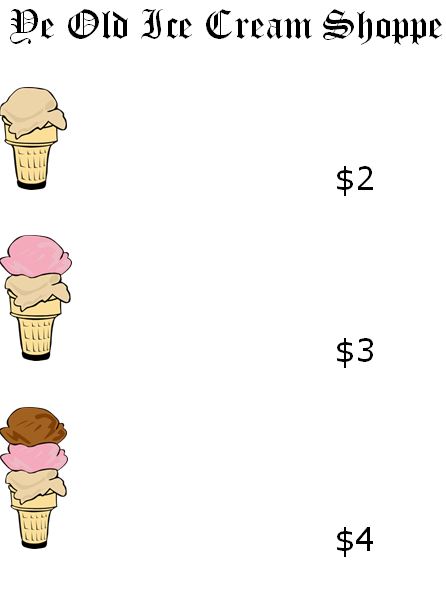
Ye Old Ice Cream Shoppe

A new ice cream shoppe opens in town and you get a part time job there. I have a visual with one scoop, two scoops & three scoops to go with this. We look at three scenarios.

scenario #1 the regular prices for the ice cream cones are $2 for one scoop, $3 for two scoop and $4 for three scoop. We map this on our diagram. Every input (cone size) has exactly one output (price). So this is a function and in fact it is a one-to-one function. This is clearly well defined, predictable, and "makes sense".


scenario #2 it is the grand opening of the shoppe and for the day all sizes of ice cream cones are $2!  Yay! so we map this on the diagram. Every input (cone size) has exactly one output (price). Yes, they all have the same price, but that's okay. It's still a function. This is also well defined, predictable, and makes sense. It is a function. 

scenario #3  your boss is out of the shoppe for the day. Your best friend comes in and he orders a 3 scoop and you charge him $2 (!) Then your least favorite person comes in and orders a 3-scoop and you charge him $5! Whoa!  Wait a minute, the input of a 3-scoop has two different outputs in this scenario ($2 and $5). Even though this might make sense to you it's really not a good thing to be doing. It is not well defined or predictable (who knows what you will charge the next person who orders a 3-scoop).
the visuals above haven't been "worked through" with the mapping arrows and labeling input/output (domain/range) and commenting on whether they are functions and why or why not. This is all something students would do. 

Interactive Student Notebook Pages for Functions

I do a couple of pages. First there is a frayer diagram on the left and sorted function cards opposite that on the right hand side.


Then we do two pages for domain & range. The left hand side compares continuous vs discrete with information about domain & range.  Here are examples for students to work out on the right side reflect under the DIXROY.  We already learned how to write interval notation, so I have them do that with domain & range.


Then I do a two page spread of "Function Machines & Function Notation" with examples on the right hand side. The "under examples" we just filled in with no foldable.


Links for each of those are contained via the descriptions above. 

Sarah Hagan has a lot of other good ideas on her blog math=love. You'll see I got a lot of my ideas from her!  Thank you again Sarah!

Addendum on domain & range. I found students had trouble with identifying domain and range in graphs especially when it got tricky. So my plan is to add one more foldable to this series here borrowing once again from math=love (this time her algebra 2 page on functions). She's got a great set of foldables and explore cards to visually understand domain and range. Read the whole entry on her blog if interested, but here are some images to give an idea of what she did.


But remembering how long cutting can take with my students and Sarah's comments about that, I will use my trusty cutting board to get those cards cut up ahead of time (or have them cut them at home the night before....)