Tuesday, July 7, 2015

Absolute Value Equations


When we first started following the Common Core in Algebra One this topic was eliminated! But we noticed it's back in when we examined an updated Algebra One Common Core list. Huh. I wonder if someone forgot it the first time?

FYI - I'm a big fan of emphasizing the whole "distance from zero" concept here when solving. So many students miss one of the solutions, so we start by drawing number lines to visualize this. And we check the two solutions to see how the two (often very different) values can work.

Here is the foldable document:


and some application work


Monday, July 6, 2015

Problem Solving (with linear equations in one variable)


Now the Common Core is supposed to teach our students to become good problem solvers. But since we are just starting out and our students only just started seeing common core materials in the last few years they haven't had that much exposure to it yet. I am lucky with this class in that they are generally like to solve problems and they will take risks and try stuff.

I do an introduction day loosely based on this MARS activity. But here are my STORY CARDS and my EQUATION CARDS. The students put those together (while working in their small groups) and make a poster. Later I'll post an image of it here.

We then get into more complex problem solving. We do some work with a modified bar model approach to give the students a visual way to set up what they know and where they are going.

Here is a more complex problem solving sheet. And the first homework and the second homework. I also challenged students to come up with complex problems and their groups and got some neat problems from them.

The ISN pages I used to support problem solving in this unit are (yeah there is a typo on the first one, but it's fixed on the foldable document here, and FYI this document is for 11x17 paper since I got a really good deal on a ream of yellow 11x17. But you can just eliminate two of the foldables and it will fit on the standard 8.5x11):


Sunday, July 5, 2015

Linear Inequalities

We now go back to inequalities. We touched upon them briefly at the start of the unit. But now we see how to solve & graph them. Headings link to documents for the foldables.

Basic Solving


Flip Flop Rules


Then we've added compound inequalities back into our curriculum (original common core Alg one did not have it, but it snuck back in an update we recently read through). I like to start by exploring the real meaning of AND vs OR with this worksheet. And for my ISN entries I have the following:

Compound Inequalities


Interval Notation


Solving Compound Inequalities


Saturday, July 4, 2015

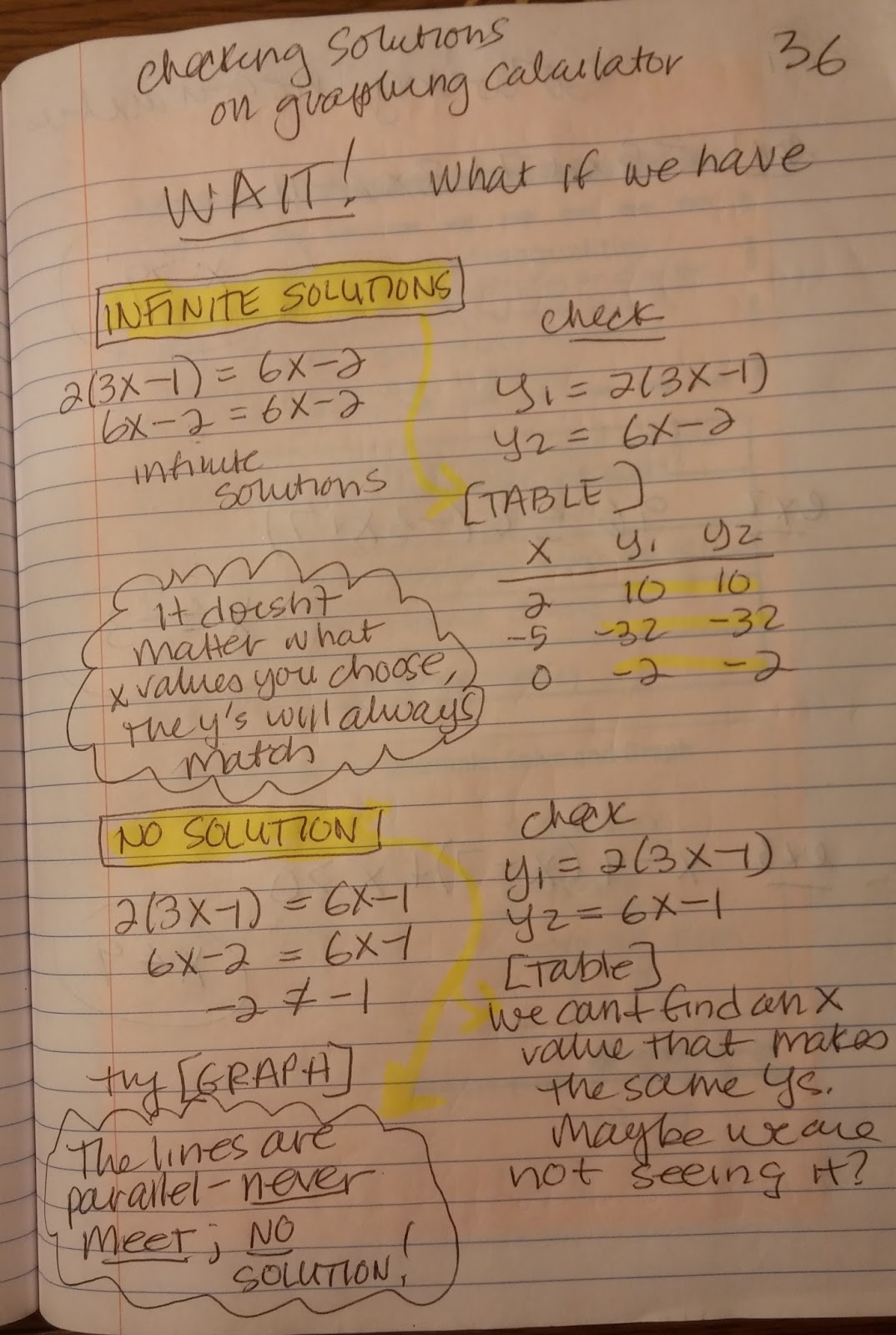
Solution Checking with Your Graphing Calculator

https://en.wikipedia.org/wiki/Graphing_calculator

Technology is a beautiful thing and I want my students to get more comfortable with their graphing calculators, so we pause a bit and see how we can check our solutions with the graphing calculator).

This involved these ISN pages:


and you can get the Calculator Graphic HERE.

Friday, July 3, 2015

Fraction Busters in Equation Solving


I remember my cooperating teacher back when I was student teaching bemoaning that fact that everyone is terrified of fractions. He would say he just has to decorate his car with a large fraction on each of the doors and no one will ever dream of stealing his car.

Fractions in equations can cause difficulty as well and I don't want students turning those fractions into decimals to deal with them (especially if they are repeating decimals and they round - ugh!!).

I address this with "fraction busters" - a way to eliminate fractions before equation solving to make life much easier!


You can find the ghost insert HERE


Thursday, July 2, 2015

Tools for Simplifying and Solving Equations


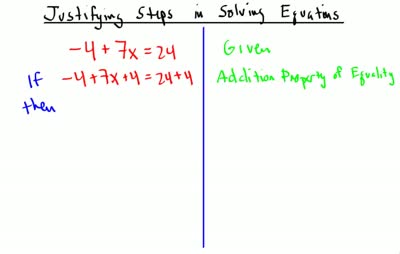
We don't just want our students to solve equations, we want them to understand the processes used in solving and justify their equation solving steps. This can be tricky for kids because it's pretty abstract to consider all this structural stuff that drives algebra. But doing this creates a really great depth of understanding. So it's a challenge to teach but if you can get it through to the kids, wow - it's great to know the "whys" of what we are doing.

Each of these headings will link to a foldable document if it's available.

We start with the basic properties of equality:


Then show how it is used in solving an equation:


But then there are additional tools for equation solving:


And more properties for simplifying 

(this one I'm tweaking for this coming school year - will add zero product property and put the number examples on the right hand page with only word descriptions in the foldable? ).


then we practice using them with problems where they justify each step in the solving process. Here are a number of worksheets. ( 1  2  3  4  5  6  ) The general format looks like this:


And then in action with multi-step equation solving (need to have them do this with justify steps on each line this coming school year).

That colorful one above is fun for the students but was a real pain to assemble! Found this foldable concept that I will probably use instead this coming school year. It's got more space so I can have them fill in reasons for justifying perhaps - will see what I come up with when the time comes!


Wednesday, July 1, 2015

Equation Solving


So now we get into equation solving. My students got a very good background in that last year in 8th grade. So we just have to review two-step and then get into 3-step. We really focus on the "undo" aspect of equation solving at first, looking at what was used to build and then go backwards to solve. I don't get into distributive property yet (even though they saw it last year). I really focus on the "undo" process.

Here are my ISN pages:


While we were going over the mechanics of equation solving, I saw some trouble spots and created a foldable to address those.

Common Problem Spots


and here is where you can access the ISN pages for your copying needs. (it's got the templates and also created examples from the internet that I used for reference when creating mine).