Thursday, August 20, 2015

A Short Rant on Technology & Time & Being Overworked

https://myucdblog.files.wordpress.com/2015/02/teacher-what-i-think-i-do.jpg?w=960

I recently read this article by Father James Martin SJ (his June 19th reflections on the Sunday Gospel reading).  Please read on even if you are not connected to any religious tradition, his thoughts on taking time for yourself and how overworked we have become in our society are very good for everyone to consider.

and I want to quote a few paragraphs of his:

    For as today's Gospel shows us, Jesus understood the value of rest and prayer......
    It's an important thing for all of us to hear. Because all of us can get into unhealthy patterns of overwork. Sometimes it’s even worn as a badge of honor: “Look how busy I am!” And, not to put too fine a point on it, but if even the Son of God needed time to prayer, so do you. So do I.
    The situation has only gotten worse as time goes on, I think. Believe it or not, when I first started working after graduating from college in 1983, at General Electric, personal computers were just being introduced. And, ironically, as hard as it may be for some younger people to believe, there were two predictions that went along with the introduction of personal computers.

    First, we would have paperless offices. Which made sense. Now that we had computers and could store all of our information on them, we would need less paper. Of course the opposite happened. With computers we were more able to write more and more and more reports and spew out more paper.

    The second prediction is that we were going to have, thanks to all the time savings that computers gave us--for example, in calculating spreadsheets, writing letters, and so on -- a lot more free time. So the widespread prediction was, believe it or not, the computer would lead to four-day work weeks. Of course the opposite happened in this case too. At this point, it feels like some of us are working round-the-clock, never out of reach of our cell phones, and always able to be gotten at by coworkers.

I can definitely relate to this. I graduated college in 1982 and took a "personal computers seminar" in college. I was blown away!  I was used to using card punch machines to create cards for each line of code, then run my 100 or so cards in a card reader and then finally wait in line at the window to the "mainframe computer room" waiting for my print-out (to inevitably find there is an error in ONE of my cards which I have to fix and start the process all over again).

Wow!

My first two jobs out of college were not in teaching (I want back to grad school for that in 1985) and we had the beginnings of personal computers in each. One used a TRS180 I think, one of the original Radioshack computers. And the other used a very early Apple computer.

Once I entered teaching, I loved using a computer to do my grades. I was not going to do all those tedious calculations for each student to determine their grade. I used some very early grading programs.

Over the years technology has advanced and there is more & more of it in our schools. We are not a paperless school (although my principal said to the whole faculty back in about 2005 that was our goal) and in fact we have to print out much more paper than ever! No one is ranting to us anymore about how much copy paper we use though, so I guess that is a plus.

And it is true, our time is really not ours. I get emails around the clock from students & parents. I spend time outside of school updating my website, updating my grades on the computer (after correcting assignments), creating lesson plans, filling out forms & evaluations, and even writing blog posts (urp).

It's important for everyone, especially us overworked and over-stressed teachers to take time for ourselves. One of my criticisms of my student teacher this past year was she worked too hard - here's a quote from my midterm evaluation
Ms. X is extremely conscientious and hard-working as a student teacher and I am so pleased with all the hard work she puts into her planning and teaching. I do have concerns that she might burn out from her high level of dedication and hope that she is able to incorporate personal stress reduction activities into her daily routines. 

And I'm not the best person to be handing out criticisms on this front. I have really high expectations for myself and always seem to be trying something new at school.

But I do take time to have other things that I do in my life. And I take out time to be part of a community that is unrelated to school that nourishes me (both my church and my yoga studio). I gain strength and refresh myself when I am in nature hiking. I enjoy cooking and baking as a relaxing activity (and especially enjoy the eating part). I eat good healthy fresh foods and take care of my health. I read copious amounts of books, they are my "sleeping pill" at night and my primary form of at-home quiet entertainment (I generally don't watch TV). And I take time to enjoy my friends and family.

Be sure you do something like that too.

Namaste.

Wednesday, August 19, 2015

Optical Illusions

http://www.illusions.org/

Now this is an old PowerPoint of mine that I put together from many different resources and use in a pinch in my classroom. It's a great fun activity to use on a shortened schedule day or when you need to fill a half hour for whatever reason.

And kids LOVE LOVE LOVE optical illusions.

And you might find PowerPoint to be such "old technology". Unfortunately we don't have much new technology in our school so we are stuck with making do with the old stuff. At least we don't use overhead projectors anymore. :)

There are lots of web sites out there on optical illusions. This one has 100 or more for you to explore. 

disclaimer - I made this many years ago and most images are not credited. Urp, sorry and thank you.

Here is the PowerPoint 

Tuesday, August 18, 2015

Vi Hart

Who/What is Vi Hart?

According to wikipedia
Victoria Hart, commonly known as Vi Hart, (/ˈvaɪ hɑrt/)[1] is a self-described "recreational mathemusician" who is most known for her mathematical videos onYouTube.[2][3][4]
Hart is the daughter of mathematical sculptor George W. Hart, and was educated at Stony Brook University.[2] As well as producing mathematical videos, she has co-authored several research papers on computational geometry and the mathematics of paper folding.[5]
Vi Hart has previously been supported by Khan Academy making videos for the educational site as their "Resident Mathemusician" and currently works in a research group called eleVR creating virtual reality videos.[1][6] She has also collaborated on educational computer games.[7][8]   https://en.wikipedia.org/wiki/Vi_Hart

And according to Vi Hart herself
I am Vi Hart! I am a real person, and I make videos and virtual reality and other things.   http://vihart.com/vi-hart-faq/ 
And in my mind, she is a super creative, smart, funny and talented mathematician. I love her videos. I use them in my classroom when I can. I watch them myself for fun.

I like to show this video when I'm doing sequences with my algebra one students


Sometimes my students are appalled that I show some of her videos because she doesn't always portray math class in a positive light. But that's okay. Math class can be boring and if you're bored any teacher would want you to daydream about math!
I've shown this about logarithms


And here is a great one to use at Christmas time:

She also has some Thanksgiving ones that I haven't watched yet....


Check out her YouTube channel  and her Khan Academy page. You can even friend her on facebook or follow her via twitter.

Monday, August 17, 2015

The Game of Skunk

http://wassclass.com/daily-math-work-term-2-continued/

Well, this is really considered a middle grades game but it IS fun and provides a little active fun for students if you have some extra time or need an activity on a shortened day.

There are number of descriptions of this game on line. NCTM Illuminations has this detailed description with activity sheets. You can even buy this game on line (why?).

And you can even develop a theoretical probability investigation with this game. See Mr. Wass's Room 21 Class Website and his entry from June 5, 2013

Daily Math Work: Term 2 – Continued

The game of SKUNK involves 5 rounds (the letters S,K,U,N,K). A pair of dice is rolled and students accumulate points represented by the sum of the numbers on the dice. A variation is to accumulate points represented by the product of the numbers on the dice.

At the start of the game, all students stand up. Dice are rolled and students earn points represented by the sum of the dice (or product). 

Students decide to remain standing (and keep accumulating points) or sit for the remainder of the round, and keep the points they've accumulated without risking losing points. 

Students who are standing choose to sit or keep standing each time the dice are rolled. If a "1" is rolled, the round is over; and all the students who are standing lose their points for that round. If double 1's are rolled, students who are standing lose all the points they've accumulated in the game.

It's an exciting game of chance and it's fun to see who sits down quickly and who is a risk taker and stays standing. 

At the start of each round as I shake the dice in my hands I chant "Sit or Stand" and throw the dice once everyone has decided what they are going to do.

You can print out a worksheet for students to use in keeping track or students can just write the letters across the page and make their own columns.

The game of SKUNK was originally created by Dan Brutlag and published in NCTM's Math Teaching in the Middle School magazine in April 1994. 

Sunday, August 16, 2015

Math Journals (another option if you don't want to do Interactive Student Notebooks OR something you can merge into ISNs)

I am one of the few people in my department who uses interactive student notebooks. I LOVE them and am really happy that I have started to use them. They are especially terrific because we really do not have a textbook so students can create their own personal textbook with these notebooks. (Although in PreCalculus we do have a textbook and I still do an ISN, the students love it there too, much more accessible than their textbook and it will be a good resource for PreCalculus).

Some of my colleagues do have students fill in a math journal, almost daily. They use composition notebooks and use it as a place to reflect at the end of class. Some also use it to have students track progress on homework and quizzes with cool little graphs.

This is a pretty cool article on how the math journals can be used and why they are useful.

And here is a neat little insert students can paste into the front cover of their journals:

I'd love to incorporate some of this journaling into my Algebra One ISN but we got to page 174 in our approximately 190 available page notebook - I'm afraid I won't have room for this!


Saturday, August 15, 2015

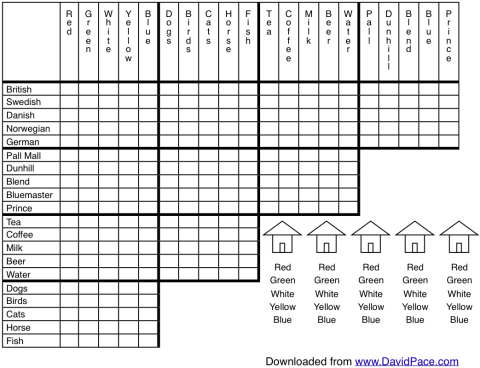
Einstein's Logic Problem


A student introduced me to this a few years ago. It is a challenging logic problem. I LOVE LOVE LOVE logic problems so I had a lot of fun with this. Dare I admit that it took me about 30-40 minutes to solve it?

This is a great problem to have available to throw the way of any students who finish their work early and want a little challenge (or don't want the challenge but they don't have anything else to do). You'd be surprised which students do very well with this problem - not always the "A" students!

There are 5 houses each with a different color. Their owners, each with a unique heritage, drinks a certain type of beverage, smokes a certain brand of cigarette, and keeps a certain variety of pet. None of the owners have the same variety of pet, smoke the same brand of cigarette or drink the same beverage.
Clues:
·         The Brit lives in the red house.
·         The Swede keeps dogs as pets.
·         The Dane drinks tea.
·         Looking from in front, the green house is just to the left of the white house.
·         The green house's owner drinks coffee.
·         The person who smokes Pall Malls raises birds.
·         The owner of the yellow house smokes Dunhill.
·         The man living in the center house drinks milk.
·         The Norwegian lives in the leftmost house.
·         The man who smokes Blends lives next to the one who keeps cats.
·         The man who keeps a horse lives next to the man who smokes Dunhill.
·         The owner who smokes Bluemasters also drinks beer.
·         The German smokes Prince.
·         The Norwegian lives next to the blue house.
·         The man who smokes Blends has a neighbor who drinks water.
Who owns the pet fish?

caution - if you let students take this problem home, they can easily google to find the answer. So beware!


other helpful links for this problem:
The text and image below provide a preview of the PDF. A full size version of the image only (good for printing out) is here. I hope this makes it a little easier for more people to test whether they can solve it.
Brain-fun has the solution posted here.


Friday, August 14, 2015

Graphic Organizers and Strategies

When we first started developing our curriculum for the common core a few years ago, all the young teachers had these buzz words that I had never heard of ...Frayer Diagram......Think, Pair, Share.....Write Around...... what?

The world of teaching mathematics is always evolving. I remember the old days when I taught in an open classroom school (ugh) and when "cooperative groups" was new.

I do find the graphic organizers and strategies very useful. I do use Frayer Diagrams and Venn Diagrams quite a lot. The other strategies I sprinkle in here & there. At the end of this blog are documents to support all this information.


Frayer Diagrams

 I use these all the time in my ISNs. You'll find examples in many of my blog posts. It's a great way to organize the definition of a mathematical term.


KWL Charts

 This graphic organizer has students list what they already Know about a concept, what they Want to know, and what they have Learned.

Venn Diagrams

Great for comparing and contrasting related math concepts. Also fun to use with problem solving.


Think Pair Share

Think-pair-share (TPS) is a collaborative learning strategy in which students work together to solve a problem or answer a question about an assigned topic. This technique requires students to (1) think individually about a topic or answer to a question; and (2) share ideas with classmate. Discussing an answer with a partner serves to maximize participation, focus attention and engage students in comprehending the material.

Write Around

In general a simple question is posed to a group, then each person in the group writes one thing in response, then we pass our papers to the left, allowing peers to comment on each of the initial reflections. 

"MathyCathy" notes on her blog post 

Revamping a Writing Strategy… for Math!

 that for mathematics classrooms:
This “write-around” strategy seemed to lend itself well to any mathematics topic that requires multiple steps, so adapting it to multi-step equations seemed to fit.  I’ve structured the activity for groups of 4-5 students.  Each student starts the activity with a different problem, then only solves the next step of the problem and signs his/her name next to the work done.  Papers pass to the left, then students analyze a new problem, as well as a peer’s work thus far, adding only the next step to the work.  If a student disagrees with the work as papers pass, he or she must consult with the “author” of the incorrect step, so the goof is corrected by the one who made the mistake.  Papers pass until all problems are solved and checked.

and More....

I know there is plenty more out there, but these are some ideas. All of these I've used in my classroom. My favorites are the Frayer Diagram, Venn Diagrams and Write Around. Let me know if there is some other graphic organizer that you've used successfully in your mathematics classroom!

For more reading - here is an interesting blog post from Jackie Murphy in using graphic organizers in math class.


Supporting Documents:

Graphic Organizers and Strategies Documents